




- Presales enablement equips SEs with the content, tools, and intelligence they need to support deals effectively — without it, SEs spend more time searching than selling
- Optimization starts with mapping SE activities to deal stages: discovery needs competitive intel, demos need tailored talk tracks, and proposals need verified technical content
- The most impactful enablement investments reduce repetitive work — automating RFP responses, standardizing demo prep, and centralizing product knowledge
- SiftHub serves as the presales enablement engine by auto-surfacing deal-relevant content, generating battlecards, and answering technical questions instantly
- Optimized presales enablement directly improves SE bandwidth — Rocketlane saw a 70% improvement in SE capacity after deploying SiftHub
- Presales enablement equips SEs with the content, tools, and intelligence they need to support deals effectively — without it, SEs spend more time searching than selling
- Optimization starts with mapping SE activities to deal stages: discovery needs competitive intel, demos need tailored talk tracks, and proposals need verified technical content
- The most impactful enablement investments reduce repetitive work — automating RFP responses, standardizing demo prep, and centralizing product knowledge
- SiftHub serves as the presales enablement engine by auto-surfacing deal-relevant content, generating battlecards, and answering technical questions instantly
- Optimized presales enablement directly improves SE bandwidth — Rocketlane saw a 70% improvement in SE capacity after deploying SiftHub
Presales is no longer just about showing up for a demo and hoping the tech speaks for itself.
As today’s buyers come with specific needs, complex requirements, and a long list of questions before they even consider a solution. They don’t just want a slick pitch, they want proof.
That’s why presales enablement has become one of the most important drivers of B2B sales success.
But here’s the problem: most companies still haven’t figured out how to set their technical presales teams up for success.
Instead of a clear presales workflow, they have scattered tools, inconsistent presale support, and tribal knowledge that never makes it past a few inboxes.
To truly scale technical wins, you don’t need more than talented engineers. You need structured presales training, purpose-built presales tools.
You need a strong enablement function that brings everything together, from content and collaboration to systems and strategy.
BTW, this isn’t just an operations challenge. It’s a revenue one. And it starts by rethinking how you enable your technical sales teams at every stage of the deal.
What is presales enablement, and why does it matter?
Presales enablement refers to the structured approach of supporting technical sales enablement teams with the resources, training, and systems needed to succeed.
These teams are responsible for surfacing real product value, mapping technology to business needs, and building buyer confidence through technical proof points, custom demos, and validation frameworks.
Unlike traditional sales teams who focus on relationship building and emotional persuasion, technical presales professionals are driven by logic, analysis, and problem-solving.
They uncover complex challenges, propose tailored solutions, and deliver scalable presales workflows that help buyers see the true value of your technology stack.
That’s why the presales process needs its own enablement model, one built for analytical minds, deep product knowledge, and value-based selling.
Technical presales vs. sales: Roles in the buyer Journey
The presales and sales teams are two sides of the same coin.
Sales builds relationships and influences buying decisions, while technical presales ensures product fit and solution accuracy.
Where sales teams use sales automation tools and CRM systems to track prospect movement through the funnel, presales teams focus on technical validation, interactive demos, and competitive intelligence.
Sales may close deals in days or weeks, but presales teams engage in long-term evaluations, product walkthroughs, and detailed discovery.
Effective sales alignment happens when both functions respect these differences.
A robust enablement function will cater to both, ensuring consistent messaging, shared frameworks, and a buyer experience that feels seamless from first call to contract.
Core functions of technical presales
Modern technical presales professionals are no longer limited to behind-the-scenes roles.
In high-performing sales organizations, the technical presales team plays a mission-critical function in shaping the buyer experience, accelerating the sales cycle, and increasing technical win rates.
They bridge the gap between customer needs and product capabilities, providing the strategic, technical, and operational support that today’s complex B2B deals demand.
Their responsibilities span multiple stages of the buyer journey and influence nearly every touchpoint with the customer.
From the first discovery call to the final technical validation, technical presales experts deliver a range of functions that drive revenue and improve deal outcomes.
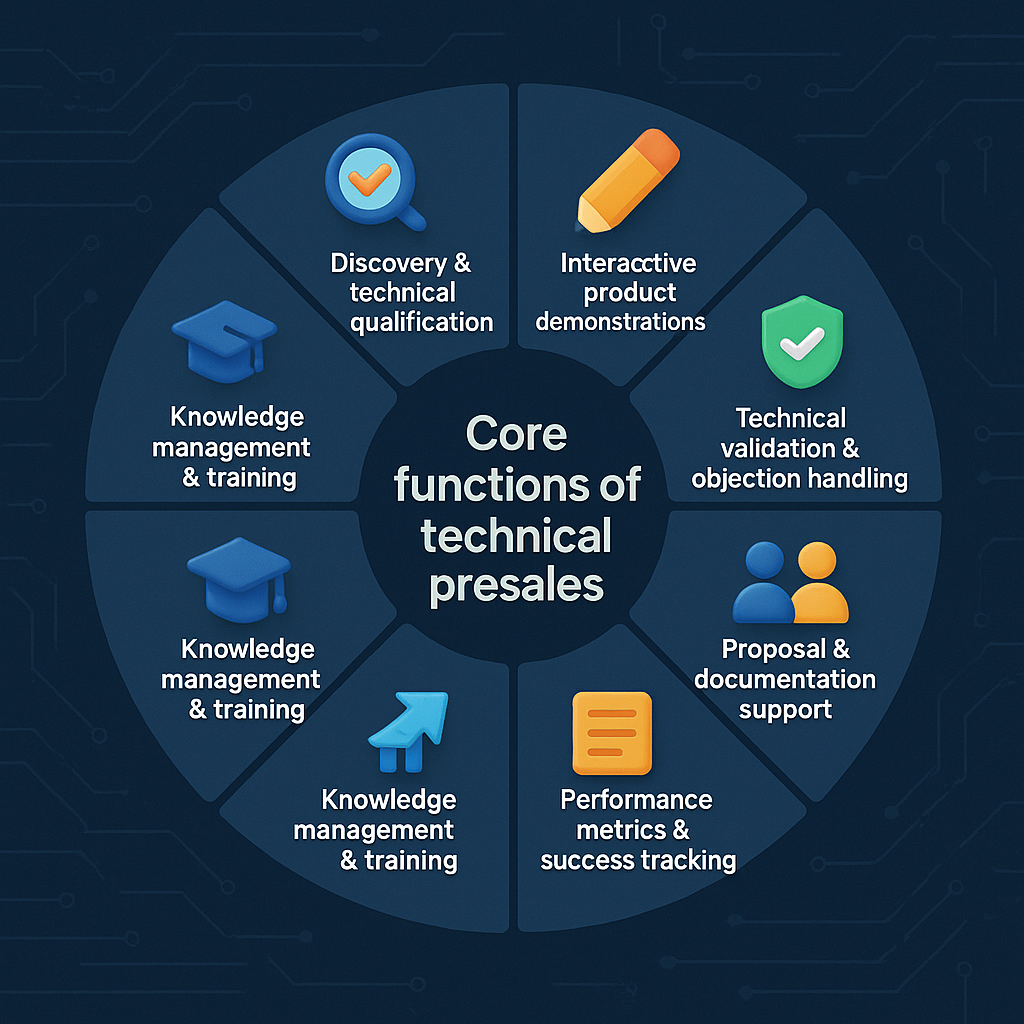
1. Discovery and technical qualification
Before any demo or proposal, the technical presales team leads detailed discovery conversations. They dig into real customer problems, tech environments, compliance constraints, and integration requirements.
This goes beyond basic qualifications; it’s about surfacing insights that shape the entire presales workflow.
A strong discovery sets the foundation for relevance, accuracy, and alignment across the sales team.
2. Solution design and customization
Once needs are clear, presales engineers design solutions tailored to the customer’s environment. This includes defining architecture, configuring features, and mapping the product to the buyer’s existing technology stack. Using a standardized pre-sales deal support template, they ensure internal clarity and seamless handoffs.
The goal is to balance creativity and feasibility, crafting solutions that solve real problems without overpromising.
3. Interactive product demonstrations
Presales-led demos aren’t just about features; they're about real-world impact.
Teams create tailored, interactive experiences that reflect the customer’s specific workflows and use cases. With the help of presale software, they can spin up sandbox environments, simulate integrations, and adjust on the fly.
These demos build credibility and show buyers exactly how the solution fits into their day-to-day operations.
Here is the top interactive demo platforms list by Gartner.
4. Technical validation and objection handling
In enterprise sales, technical validation often includes formal evaluations like PoCs, security reviews, and integration testing.
Presales teams must prove that the solution meets detailed requirements and passes scrutiny from IT and procurement teams.
At the same time, they handle objections, both technical and strategic, turning concerns into strengths. This stage is key to building trust and advancing the deal.
5. Collaboration across the sales organization
Technical presales acts as a strategic connector across the sales organization.
They translate customer feedback into insights for product teams, support competitive intelligence efforts, and align closely with marketing and AEs.
In companies with a mature enablement function, presales play a central role in refining messaging, shaping roadmaps, and closing feedback loops quickly.
Their input drives sharper GTM execution.
6. Proposal and documentation support
Presales often owns the technical side of sales documentation, creating security responses, architecture diagrams, integration plans, and technical justifications.
These assets are critical in long-cycle deals and often influence procurement decisions. A well-organized knowledge management system with version-controlled templates helps ensure consistency.
This makes presale support faster, scalable, and more accurate across multiple deals.
7. Knowledge management and continuous training
With fast-moving products and shifting buyer expectations, presales teams need constant upskilling.
Organizations invest in presales training programs or internal presales academies to keep skills sharp. They also build centralized repositories that capture past solutions, objection-handling tactics, and validated demo scripts.
Good knowledge management reduces ramp time, increases consistency, and improves team performance over time.
8. Measuring success with performance metrics
Finally, technical presales teams must show their impact using clear performance metrics.
These often include:
- Technical win rates
- Deal velocity and sales cycle duration
- Demo engagement scores
- Influence on ARR or revenue
- Utilization rates of demo infrastructure
- Feedback from customer satisfaction surveys
The case for a structured presales workflow
Without structure, presales become chaotic. Teams field one-off requests, build demos from scratch, and scramble to gather collateral.
A well-designed presales workflow transforms this chaos into clarity.
A good workflow includes:
- Standardized discovery templates and pre-sales deal support templates
- Prebuilt demo infrastructure and technical environments
- Access to a centralized knowledge management system
- Role clarity and handoff guidelines between sales and presales
These frameworks reduce errors, improve efficiency, and ensure a repeatable, high-quality experience.
As technical presales scales across global teams, workflow consistency becomes the bedrock of operational success.
Common pitfalls in presales enablement
Despite investments in presale software or CRM systems, many organizations fall short due to recurring issues:
- Inconsistent execution: Without standard demo workflows or shared performance metrics, technical presales efforts vary by individual. This leads to uneven customer experiences.
- Slow ramp times: New hires lack proper onboarding paths. Without a presales academy or continuous training program, it can take months for solutions engineers to become revenue-ready.
- Siloed collaboration: Disconnected sales, product, and presales teams lead to conflicting priorities and misaligned messaging. This also weakens the product gap management process.
- Poor knowledge management: Institutional knowledge remains trapped in Slack threads or individual minds, instead of being stored in a presales content library.
Building an enablement function that serves technical sales
Presales enablement thrives when approached like any other strategic discipline.
That means assigning dedicated enablement resources, defining outcomes, and using the right presales tools to support every step of the process.
Here are the foundational pillars:
- Presales academy: A structured learning journey combining self-paced modules, scenario-based roleplay, and performance-based coaching.
- Pre-sale support systems: Tools and templates that guide teams through discovery, demo creation, and proposal drafting.
- Technology stack alignment: Integrated platforms that connect CRM systems, demo tools, and content repositories.
- Continuous training: Regular refreshers on new features, competitive intelligence, and evolving market trends.
- Cross-functional feedback loops: Shared retrospectives between sales, product, and presales to inform roadmap and go-to-market strategies.
The role of technology in enabling presales excellence
A modern presales enablement strategy relies heavily on the right technology stack. These aren’t just nice-to-haves; they are essential.
- Presales management platforms: These tools provide visibility into team performance, demo activity, and pre-sales workflow execution. They offer deal assignment features and help track time spent on each opportunity.
- Interactive demo tools: Platforms that allow solutions engineers to quickly create reusable, interactive demos without needing engineering support.
- Content collaboration software: Tools that centralize proposal templates, battlecards, and technical briefs.
- Sales automation and CRM systems: Core systems that streamline coordination, track engagement, and align sales and presales actions.
- Product documentation and knowledge management: Platforms that help technical presales teams access accurate, updated information quickly during live calls.
When combined, these tools eliminate inefficiencies, reduce repetitive work, and allow solutions engineers to focus on what matters most: solving customer needs and increasing technical win rates.
Best practices to optimize your presales process
- Invest in presales training: Regular, structured training ensures your team can keep up with complex products, market trends, and competitive positioning. Consider launching a full presales academy.
- Standardize demo workflows: Build out reusable templates and demo infrastructure. This reduces manual work and maintains brand consistency.
- Leverage data and performance metrics: Use metrics like revenue per demo, time to value for new hires, and deal conversion rates to guide decision-making.
- Prioritize buyer-centricity: Demos should focus on solving customer problems, not showcasing product features. Technical presales must tailor every interaction to customer needs.
- Foster sales alignment: Shared sales methodologies, clear handoff rules, and joint pipeline reviews build trust and streamline execution across functions.
Continuous improvement through feedback and measurement
Presales enablement isn’t a one-time setup; it is a living system that must evolve as products, markets, and buyer expectations change.
The most successful technical sales teams treat enablement as an iterative process, driven by measurable outcomes and structured feedback loops.
High-performing organizations build this continuous improvement cycle around three pillars: training, analysis, and optimization.
They don’t just measure activity, they measure impact.
Every demo, discovery call, and proof of concept becomes an opportunity to learn, refine, and optimize the presales workflow for future sales engineering success.
Use these feedback loops to:
- Analyze demo effectiveness and update templates accordingly: Track demo engagement rates, time spent, and follow-up conversions to understand which interactive demos are resonating the most with customers. Optimize demo environments and presentation flows based on these insights.
- Identify product feedback trends and relay them for product gap management: Capture recurring technical objections and feature requests from presales calls to inform roadmap decisions. This tightens the feedback loop between presales, product, and engineering.
- Adjust onboarding content based on ramp-up timelines: Monitor how quickly new solutions engineers reach full productivity using presales metrics like time-to-first demo or deal support readiness. Use data to refine presales academy modules or technical sales enablement programs.
- Capture lessons learned after major wins or losses: Conduct structured retrospectives that evaluate discovery calls, proposal quality, and technical validation depth. Document learnings in your presales content repository to prevent repeat mistakes and replicate successful plays.
A feedback-driven culture ensures your presales performance keeps pace with customer expectations and market shifts.
By continuously measuring demo effectiveness, technical win rate, and overall presales efficiency, organizations can transform ad-hoc improvements into repeatable excellence and sustainable buyer enablement.
Ultimately, continuous improvement isn’t about adding more tools — it is about building smarter systems that learn from every deal.
When combined with the right presales management platform, these insights turn day-to-day operations into a compounding advantage for long-term revenue growth and team alignment.
How SiftHub optimizes presales enablement
At SiftHub, we understand that great presales outcomes come from more than just skilled engineers; they require systems that enable consistent execution at scale.
Our platform empowers technical sales teams with a comprehensive suite of presales tools designed to reduce manual work, accelerate ramp time, and improve technical win rates.
With SiftHub, your solutions engineers get access to a centralized presales content library, AI-powered knowledge management, and dynamic demo infrastructure that streamlines interactive demos.
We simplify cross-functional alignment by integrating with your existing CRM systems and enabling seamless collaboration between presales, sales, and product teams.
Our tailored presales support modules, smart deal insights, and continuous training programs create a presales academy-like experience inside your workflow.
Whether you’re creating a new presales deal support template or refining demo workflows, SiftHub makes the process faster, more scalable, and more effective.
Presales enablement is no longer a nice-to-have; it’s a strategic differentiator.
With SiftHub, you gain the tools and insights to make technical presales a true revenue-driving presales function that elevates every part of your sales organization.

.avif)