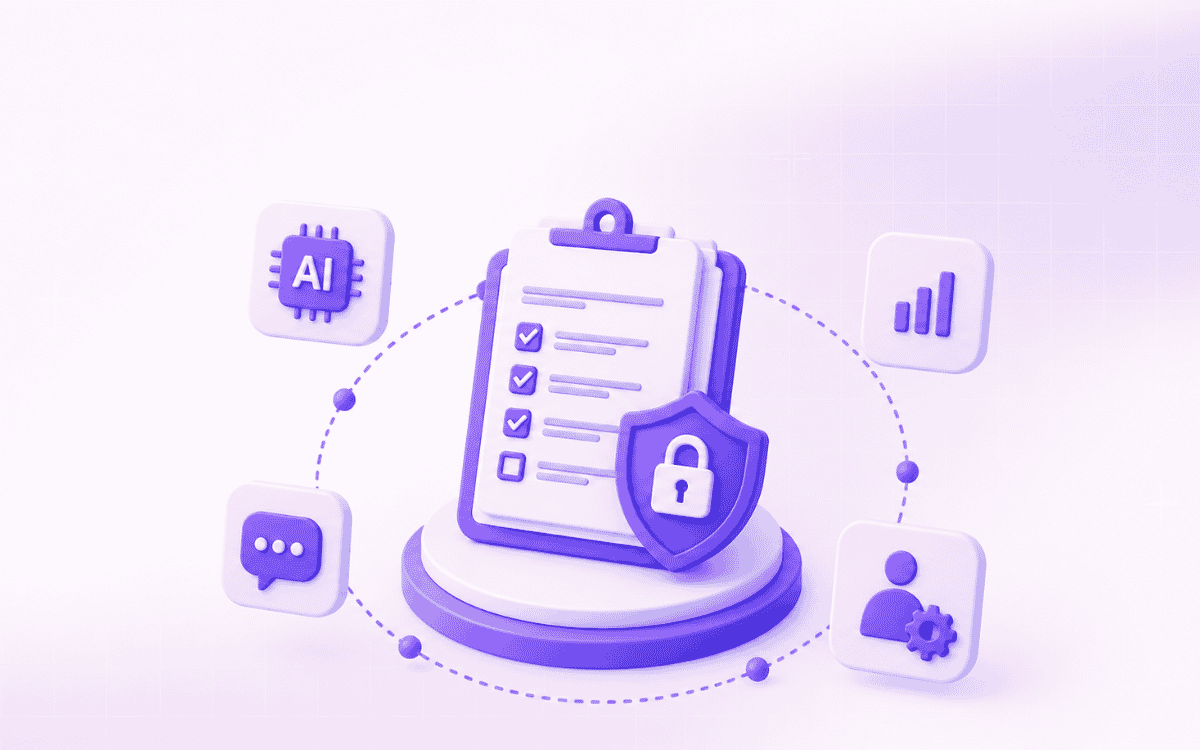




- Enterprise AI tools differ from consumer AI in critical ways: data security, compliance certifications, role-based access controls, integration depth, and audit trails.
- Consumer-grade AI (generic chatbots, free LLMs) lacks the governance and accuracy requirements that enterprise sales and presales workflows demand.
- Enterprise AI tools like SiftHub provide SOC 2 Type II and ISO 27001 compliance, do not train on customer data, and offer full source attribution on every output.
- The 'superiority' is not just about features — it is about trust. Enterprise buyers will not accept AI-generated proposals or security responses without verifiable accuracy.
- Teams that invest in enterprise-grade AI tools avoid the compliance, accuracy, and security risks that come with repurposing consumer AI for business-critical workflows.
- Enterprise AI tools differ from consumer AI in critical ways: data security, compliance certifications, role-based access controls, integration depth, and audit trails.
- Consumer-grade AI (generic chatbots, free LLMs) lacks the governance and accuracy requirements that enterprise sales and presales workflows demand.
- Enterprise AI tools like SiftHub provide SOC 2 Type II and ISO 27001 compliance, do not train on customer data, and offer full source attribution on every output.
- The 'superiority' is not just about features — it is about trust. Enterprise buyers will not accept AI-generated proposals or security responses without verifiable accuracy.
- Teams that invest in enterprise-grade AI tools avoid the compliance, accuracy, and security risks that come with repurposing consumer AI for business-critical workflows.
Two broad kinds of AI tools exist in the market—those designed for consumers, and those for enterprises. While the end goal of these tools remains the same – automate mundane tasks, tie together existing data to produce unique outputs, and improve overall productivity – important differences exist between consumer and enterprise AI tools.
While consumer AI tools are accessible and easy to use for individuals or small teams for their everyday tasks, enterprise AI tools, like Salesforce AI, are trained for specific business use cases.
Consumer AI tools require no enterprise-level expertise or resources; point and click (or type and submit) for AI to lend a hand with small-scale tasks, such as writing a generic email. Enterprise AI tools, on the other hand, are meant to handle niche activities like bringing together product knowledge to empower sales professionals to respond faster (and better), providing summaries, insights, and next steps post a customer call, identifying customer behavior patterns to drive more personalized marketing, and more.
In this article, we will attempt to understand why enterprise AI tools are better suited for businesses over generic, all-encompassing tools like ChatGPT, or for that matter, GPT wrappers.
Why are enterprise AI tools better for organizations?
Clara Shih, CEO of Salesforce AI, said in a press conference that ChatGPT or related tools can't always help with business-specific questions due to a lack of data and metadata. What this means is that businesses have unique needs that cookie-cutter consumer GenAI tools can't satisfy. That's where enterprise-grade AI platforms shine, as they offer:
- Features specific to business functions
- Better integration with existing systems
- Tighter data privacy and security controls
- Specialized support to ensure compliance with industry regulations
- Ability to make decisions by processing actual business data
But wait, what about GPT wrappers?
Consumer and enterprise AI tools are both evolving, but we see somewhat of a middle ground with GPT Wrappers.
A GPT wrapper is a user-friendly interface integrated within other systems that connects with a GenAI via an API call. They are general-purpose, easy to implement into pre-existing workflows with minimal setup, and typically more affordable. Thus, they are good for some small-scale operations.
While GPT wrappers provide a rapidly deployable and cost-effective way to implement AI capabilities in a website or system, enterprise AI does so much more. They give you a comprehensive solution with a broad range of applications beyond just language processing. This includes predictive analytics, automation, intelligent data processing, and more. They are also far more scalable, adaptable, and customizable, making them the superior choice for enterprise-level long-term business growth.
Talking about wrapper startups in an interview Google CEO Sundar Pichai states, “It’s not bad to be a wrapper, you shouldn’t be a shallow wrapper…make sure you are doing something that isn’t being done by the model itself. That will have a short shelf life.”
That said, let’s look at why enterprise AI tools are the best option for businesses in more detail.
- Rich customization
Business AI tools are solutions designed to help with specific business functions and are thus customizable to unique functions and operational scenarios. They are trained with use cases for business scenarios, which gives them an edge over consumer-grade AI tools. This allows companies to tailor these tools to fit their industry, processes, and even the jargon they use. By integrating these specialized capabilities, businesses can get more accurate insights, make better decisions, and run more efficiently.
- Integration with your existing tech stack
Companies usually already have a tangle of systems handling everything from customer data to operations to analytics. Enterprise AI tools have a big edge in this scenario. They're built to smoothly plug into those existing company setups like your ERPs or CRMs, instead of requiring rip-and-replace overhauls or operating outside the network. Once integrated, they are all set to process information within your tech stack for their work.
- Built with compliance, data privacy & privacy in mind
Enterprise AI tools aim to achieve airtight security to prevent unauthorized eyes from peeking at proprietary data. Moreover, unlike consumer AI tools, these platforms come equipped with advanced security protocols.
We're talking features like multi-factor authentication to verify user identities, granular access controls to restrict system permissions, and regular third-party audits to identify vulnerabilities.
They protect data such as personality identifiable information (PII) of consumers and employees alike by encrypting sensitive data and adhere to strict data privacy and security standards like GDPR, HIPAA, and SOC 2, by providing features for data anonymization and secure data handling practices.
More importantly, enterprise AI tools are designed not to use organizational data for training purposes, something consumer AI tools do so often. Samsung has been in the news when its employees unintentionally shared sensitive data with ChatGPT, leading the tech giant to ban the use of ChatGPT and other AI chatbots.
- Support, maintenance & SLAs
Consumer-grade AI tools do not offer the level of dedicated support and service guarantees that businesses require. Enterprise AI vendors go all-in with comprehensive support offerings, such as dedicated support teams, regular updates, proactive monitoring, and maintenance.
Perhaps more importantly, these enterprise platforms come with solid service level agreements (SLAs) that guarantee uptime, performance, and responsive issue resolution. For any company relying on AI for core operations, these contractual SLAs are absolutely vital.
- Freedom from hallucinations
If you ask ChatGPT to count the number of Rs in the word ‘strawberry’, you will find it confidently replies, ‘two’, and not ‘three’. This tendency for LLMs to generate untrue, wrong outputs with confidence is what’s termed as hallucinations. It arises because LLMs are trained on large sets of data, and they can sometimes find patterns that do not exist.
Enterprise AI tools are designed to minimize hallucinations through rigorous data validation, stringent quality controls, and specialized training on domain-specific datasets. Unlike generic consumer AI tools, which are trained on vast, diverse, and sometimes unreliable internet data, enterprise AI tools use high-quality and more specific datasets and incorporate robust feedback mechanisms to ensure accuracy and reliability. They also often include mechanisms for human oversight and continuous monitoring, to pinpoint and eliminate low-confidence outputs.
The future of consumer and enterprise AI tools
The future of enterprise AI tools is marked by significant advancements in model optimization, multimodal systems, API-driven microservices, and self-improving AI. These tools will become more efficient, flexible, and capable of handling complex tasks, prioritizing both ethical concerns and data privacy. This also means enterprise-grade AI tools are all set to diverge from generic tools to solve more specific business problems.
Estimates suggest that enterprise spending on generative AI solutions, including software, hardware, and IT/business services, is forecasted to reach $143 billion by 2027, up from $16 billion in 2023. This is because these tools are actually helping businesses save money, time, and resources much more than non-specific AI solutions ever can.